Of Mice and Men: Quick Start Guide

THE OPERA IN ONE SENTENCE
George and Lennie, a pair of ranch hands in Depression-era California, dream of owning a farm of their own, but their hopes are thwarted after a fatal accident.
BACKGROUND
Following the Stock Market Crash of 1929, the United States was plunged into the decade-long Great Depression. Many Americans suddenly found themselves jobless and were forced to move in search of employment. In his 1937 novella Of Mice and Men, author John Steinbeck chronicled the plights of agricultural migrant laborers in California, who traveled from farm to farm and worked in poor conditions for little pay. The book was an experiment in what Steinbeck called “Is” Thinking—representing a story objectively, without trying to impose any judgment or meaning on the events.
Having witnessed the effects of the Depression during his childhood in South Carolina, composer/librettist Carlisle Floyd was drawn to Steinbeck’s novella, which he called “a study of human attachment in an environment of harsh personal isolation and despair.” When he began adapting the book into an opera, Floyd sought the input of Steinbeck, who approved his libretto. However, the project proved an immense challenge—Floyd spent seven years revising the opera until its Seattle Opera premiere in 1970. It remains one of his most popular and enduring works, second only to his masterpiece Susannah.
WHAT TO LISTEN FOR
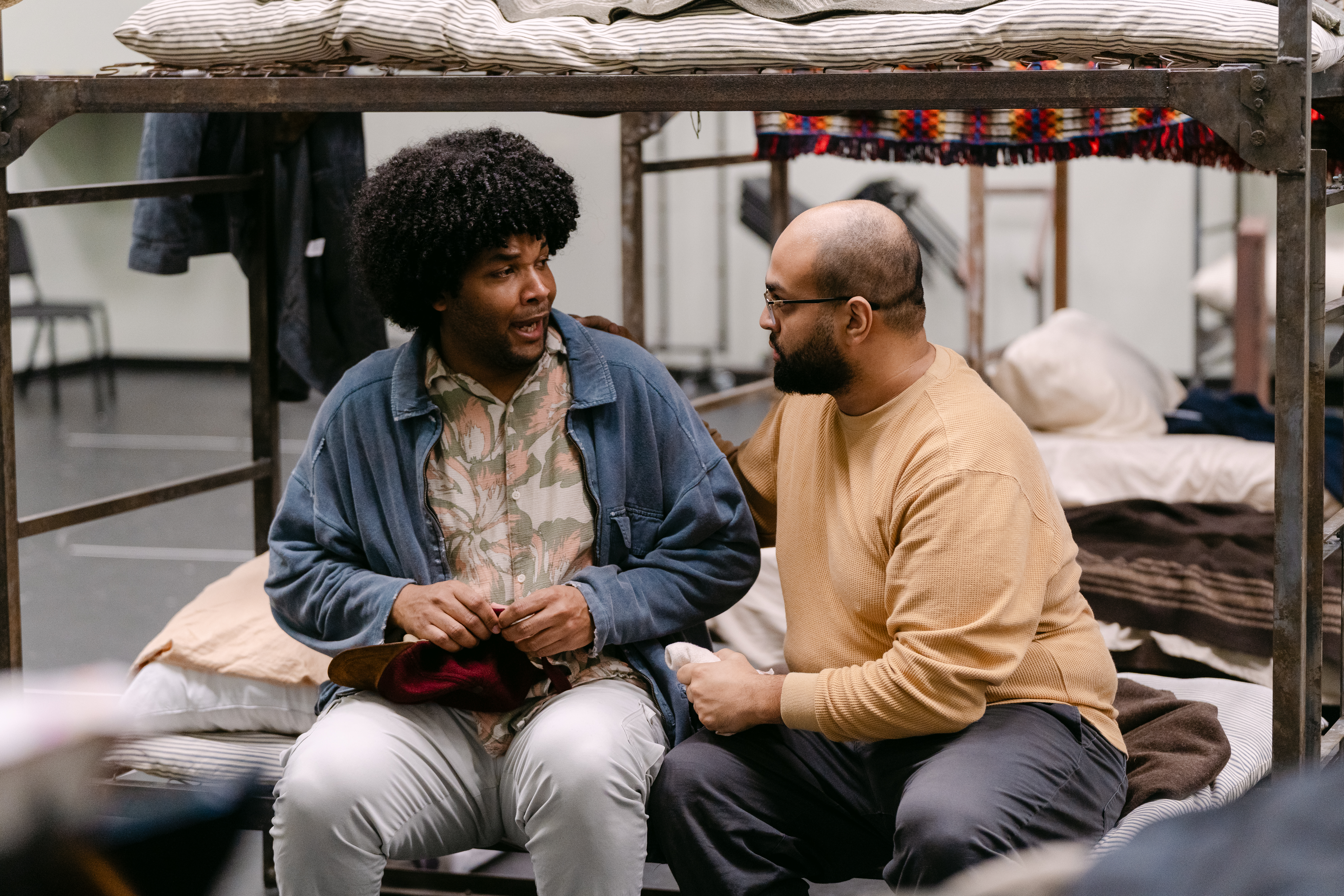
The opera opens with blaring trumpet and dissonant strings that represent George and Lennie running from the police. Following this chase music, George vents his frustration at having to look after Lennie in his aria “My life would be so simple by myself.” Listen for its back-and-forth melody that suggests George is trying to make up his mind whether to stick with him. Lennie responds with “It was somethin’ I could stroke,” about the furry mouse he killed. Its tender main theme conveys the character’s childlike innocence. George reassures his friend in “One day soon,” describing their dream farm in a comforting tune inspired by American folk music. Once they reach the ranch, the companions encounter the harmonica-playing Ballad Singer, who croons his mournful tune “Movin’ on.”
In his Act II aria “I ain’t gonna buck grain the rest of my life,” George vows that he and Lennie will break free of their existence as wandering ranch hands. Listen for the climax on the words “I’ll never settle for this life,” which he sings on a hopeful, soaring theme. In the humorous trio “Just think of owning a place of our own,” George, Lennie, and Candy picture the laidback life they’ll lead on their farm. Listen for its unusual meter that alternates between a measure of seven beats and a measure of five.
In Act III, Lennie and Curley’s Wife share a duet about their dreams, but they don’t seem to truly hear each other. Their separate lines “weave in and out while they remain independent,” as Floyd put it—a musical technique known as counterpoint. In the final scene of the opera, listen for the tragic reprise of George’s “One day soon” as he prepares to shoot Lennie.
FUN FACT
The title of Steinbeck’s novella comes from Robert Burns’s 1785 poem “To a Mouse,” about a mouse whose nest is destroyed by a plow. In its most famous line, Burns writes, “The best-laid schemes of Mice and Men go oft awry”—or, in other words, things usually don’t go as we anticipate, whether we’re human or rodent.
SYNOPSIS
Setting: An agricultural valley in northern California, 1930s
ACT I
George and Lennie, a pair of migrant workers, are on the run from the police. Lennie, who has an intellectual disability, landed the pair in hot water when he tried to feel a girl’s soft dress. George expresses his frustration—his life would be much easier if he didn’t have to look after Lennie. He notices that his companion is hiding something and discovers it’s a mouse that Lennie accidentally petted to death. To comfort Lennie, George tells him about the farm they hope to buy one day—a place where George can keep Lennie out of trouble.
The following evening, hotheaded ranch owner Curley waits impatiently in the bunkhouse where his employees live. George and Lennie were supposed to start work that day but never showed up. Curley’s Wife, starved for attention, enters and begs her husband to take her out. George and Lennie finally arrive and are greeted by the ranch hands, including the elderly Candy. Curley’s Wife returns and tries to flirt with the men, who refuse to take the bait. Suddenly, everyone smells the stink of Candy’s old dog. The ranch hands insist Candy put the poor beast out of its misery, and the assistant foreman Carlson takes the dog out and shoots him.
ACT II
Several days later, George is in the bunkhouse and finds a newspaper ad for a farm that fits what he and Lennie are looking for. Candy overhears their excitement and offers to go in with them on purchasing the property. As the three imagine their bright future together, Curley’s Wife interrupts them. When Curley discovers his wife in the bunkhouse, he jealously tries to pick a fight with Lennie, who breaks Curley’s hand. Slim the foreman suggests a deal—if Curley doesn’t fire George and Lennie, they promise not to tell anyone how he was injured.
INTERMISSION
ACT III
The following afternoon, Lennie is hiding in the ranch’s barn—he accidentally killed the puppy Slim gave him and doesn’t want George to know. Curley’s Wife enters carrying a suitcase, ready to run off to Hollywood. She shares her dream of becoming a film star, and Lennie relates his plans for the farm. He tells Curley’s Wife about his love for soft things, and she lets him feel her hair. But when his stroking becomes too rough, she tries to free herself, and he accidentally snaps her neck. Realizing he’s done something awful, Lennie slips away. The ranch hands discover the dead body of Curley’s Wife, and Slim urges George to act fast—he has to steal a pistol and get to Lennie before Curley does.
George finds Lennie in the woods as Curley and a lynch mob are heard approaching. Distracting Lennie with a description of their farm that will never be, George puts a gun to his friend’s head and pulls the trigger.
HGO PERFORMANCE HISTORY
HGO previously performed Of Mice and Men during the 1972-73, summer 1977, and 2001-02 seasons.